by Néstor Cevasco
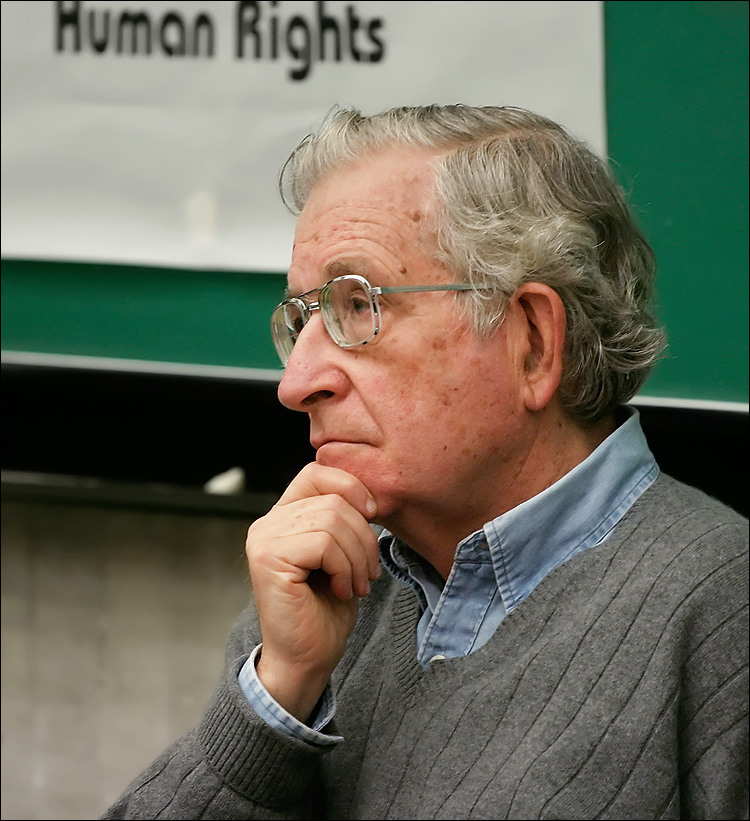
After analyzing the text entitled ‘Empire or Independence’, anyone can become aware of an oppressive atmosphere between the British Empire and the American Colonies of the society of the 17th Century. Naturally, the immediate reaction of these colonies towards this situation jointly with a British Crown imposition of a tax was turning out to be that of rejection and social intolerance. For this matter, the selection of a text entitled ‘On the Rise of the South’, where Noam Chomsky, by far a prestigious American Linguistic and actual political analyzer widely recognized all over the world, comments on the actual situation of the developing South American countries in relation to the IMF and the World Bank, relationship which has been considered by some analysts to have some oppressive features as well.
Being asked about the importance of some South American initiatives like the Bank of the South and how such projects could weaken the mentioned financial institutions, Chomsky expresses a very positive point of view. He refers to The Bank of The South as an important initiative supported by the big Brazil which cooperates with Venezuela and the rest of the Latin countries. Chomsky goes on explaining on a situation of disintegration pictured as a confrontation among social classes, where the South Bank happens to be just the result of such confrontations. This disintegrative process can be understood in both senses. For one thing, the Latin American countries are becoming to overcome after several years their conflicts of separation among nations. In fact, there have recently been a meeting of all South American presidents to discuss on the assistance of Bolivia, country which is undergoing a period of huge social tension. For another thing, he refers to a disruption between a rich, mostly white Europeanized elite and a massive population. Particularly on this, he focuses on the Bolivian conflict where there’s an existence of a white European elite, a minority just representing themselves, who happen to be controlling the nation hydrocarbon reserves. In addition to this, Democracy seems to be a negative point, as far as the prestigious Linguist is concerned. In this sense, Bolivia has become in these years more democratic, situation despised and considered to be dangerous by the West. In better words, Chomsky explains that when the indigenous majorities took the political power in a democratic election, the reaction of the West was that of Hostility since, for instance, The Financial Times condemned Evo Morales as moving to a dictatorship just for favouring oil nationalization. However, the prestigious newspaper omitted to mention that Evo Morales had been supported by a 90 % of the Bolivian population, situation which by far is democratic rather than a dictatorship.
As a counterpart to disintegration, Chomsky refers to integration in the form of The Bank of the South, where this writer would add the Mercosur. On this matter, Chomsky argues that such initiatives could weaken financial institutions like The World Bank or The IMF. Indeed, the IMF has been mostly thrown out from South America. In fact, Argentina has openly manifested his getting rid of it, after following rigorously during many years its policies, which led the country to an economic collapse never seen before. In addition to all this, Chomsky in a very clever way explains the way the IMF works: ‘You lend money to a dictatorship and elite, the population has nothing to do with it, you get a high interest because the operation is risky, they say they can’t pay it off, you say Okay your neighbours will pay for it. This is called structural adjustment. And my neighbours will pay me off. That’s the IMF creditor’s cartel. You get higher taxes from the north.’ (Chomsky: 2008).
As regards the World Bank, it’s interesting to advertise the way this institution operates in South America. In Bolivia, for instance, Chomsky refers to uprisings of indigenous populations after the World Bank’s decision to privatize water. Obviously, this meant something to private investors, but nothing to poor people which happen to be vast majorities in Bolivia and whose access to water would turn out to be a matter of serious difficultness. For this reason, the population in Cochabamba forced the water companies to pull out, and the World Bank had also to pull out its project, even though some other private projects like this are ready, waiting to be approved…
As a conclusion, the present situation is different from that of the earliest Americans in relation to the British Empire during the 17th Century in terms of the actual inexistence of such a thing like an empire oppressing other weaker countries to accept its impositions. However, after reading Chomsky, what it seems to exist are private world financial institutions like the IMF or he World Bank whose economical recipes adopted by economy ministers of the country debtors, might not have oppressed people, but have surely created economical collapse, as Chomsky very well has said, and have contributed to perplexity on vast majorities. Frankly speaking, reading Chomsky is highly recommended not only because of his simple style of writing, but because of the fact that he denounces what he clearly perceives as social injustices.

9 comments:
Well, though you explain extremely clear, this piece of reading is not one which I would like to read.
Well, thanks Gabriela.I know that politics is boring. The problem is that this paper should have been sticked on the other blog of Language and Culture III, where we are dealing with more political texts. Anyway, I am considering some other topics to write about here, obviously not related to political matters. Bye. nestor
Nestor,this is just what I was going to tell you. That paper is connected with culture III.
I think that your text is interesting and would be a good topic for discussion in third.
People, I would recommend you to re-read the reasons by which this blog was created.
I don't like politicians, but when a great philosopher, in this case Noam Chomsky, is talking about nowadays political changes I cannot stop feeling interested in the topic.
The panorama that Chomsky explains over the situacción generated by the new independent economic policies of South American countries and of some others of the rest of the world is both revealing and worrying. I have read "Chomsky on the Rise of the South" where he says "The United states, by now, has a military system; more is spent on the military system than the rest of the world put together. There's a reason for that. That's not to defend the borders." Now, I wonder what the rest of the world can do to stop them doing this?
Well, I think this is a very interesting review. I like reading about politics because of its connection with history, and besides, I think that by knowing about history and politics as well, people is better able to understand their own world and the proccesses that take place in it. Specially when there are winds of change, something I think is happening in nearly all South American countries. I know that´s not easy to free ourselves from the North opression, but, in a way, I truly believe our leaders have become aware of the need to take another direction as regards politcs.
Hi Romina, with reference of Chomsky's comments on American powerful militarization. One of its probable reasons can be traced by looking back to History, as Mariana has very well pointed out. During the 50' or 60', I cannot remember exactly when, Fidel Castro set up a series of intercontinental missils in Cuba which pointed towards USA. So, Kennedy recommended the Russians to take them off. If not, a new 3º world War could begin. It was a period known as 'Cold War' where the most powerful countries suspected each other to be dangerous, for a race to nuclear armamentism had also began. Careful, by this I am not consenting such militarization, I'm just guessing its possible reasons. By the way, one should also be worried about ones own country systematic dismilitarization, which happened to occur during the 90', and where national projects such as the design of a missil called 'Condor' dissapeared as well as many other national initiatives;(Pino Solanas films are higly recommended to work out on these issues). Imagine the hypothetical case that Chileans were to take the Patagonia to steal the water from the Southern Lakes, I do not sincerely think we are prepared to force them leave the country. This is one of the problems of being military weak, there are greater chances of being invaded, provided there's a good motivation for doing so. Bye. Nestor
I THINK POLITICS IS VERY INTERESTING, AND AS MARIANA SAID WE HAVE TO KNOW OUR PAST TO UNDERSTAND PRESENT AND WE WILLBE ABLE TO PREDICT OUR FUTURE. I AM SURE THE PROBLEMS BOLIVIA HAS IS DUE TO USA GOVERMENT WHO HAS A TERRIBLE ECONOMICAL CRISIS AND THEY HAVE TO DRINK THE ECONOMICAL RESOURCES FROM THE POORER LATIN AMERICAN COUNTRIES, AS THE OLDEST SPANISH AND BRITISH IMPERIALISM HAD DONE BEFORE. THEY DO NOT CARE ABOUT KILLING PEOPLE TO ACHIEVE THEIR PROPOSE. OUR AIM WILL BE TO DEFEND OUR COUNTRIES AGAINST THEIR COLONIALISM. DE MARIA LAURA
I really liked this article. I think is very important to know about what happens around the world like, for instance, in Bolivia. I totally agree with Chomsky about this topic. I think that this problem in Bolivia represents not only their history but what has happened in all the region, our country included. This situation of a minority holding most of the richness of a country is very well known by us. I remember having studied about the Sociedad Rural and them supporting the military governments against the democratic ones. I hope everything can be solved in favour of the indigenous and countrymen. It is unbeliavable
they,the real owners of the land, cannot acess to essencial things like gas. Also, I agree with Nestor about Chomsky, I think this author is very clever and their articles are very interesting. It woulkd be very interesting to have more articles like this one.
Jésica López
I agree with Mariana and Maria Laura. I don`t like politics very much, but I think that trying to understand it a bit more ill help our country to grow up. I remember only the 2001's "depression", because I'm 19 years old; but I believe that if our society could born again after all the things that had happened, we have a posibility to get rid of all this (I hope so).
Post a Comment